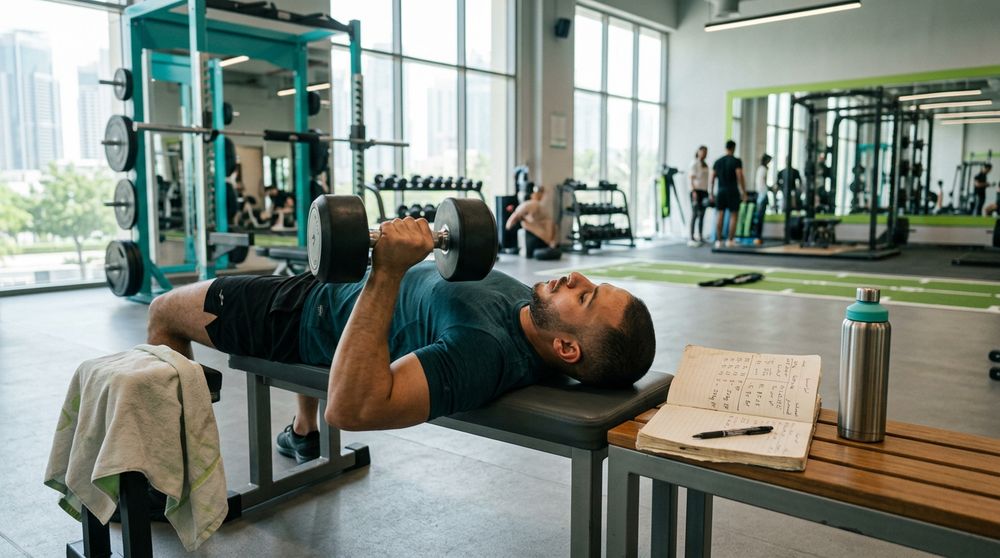
Muscle Growth Stalled? 7 Common Reasons You've Plateaued and a 4-Week Plan to Break Through
You train regularly and eat well, yet the weight on the bar has not moved and your arm measurement has not changed for a month? That is called a plateau, and it is completely normal for beginners and experienced lifters alike. The practical takeaway: a plateau is usually not a flaw in your body but a sign that one of four levers needs adjusting: progressive overload, training volume, protein and calories, or sleep and recovery. In this guide from Prof Health we explain seven common causes, what the research actually says, and a simple 4-week plan to break through that fits life in Riyadh.
Have you really hit a plateau?
Do not judge after a single week. Work stress, one late night or a salty meal can temporarily change your weight and strength. A true plateau means about four weeks of consistent training in which the weights or reps on your main lifts have not gone up, your body measurements (arm, chest, thigh) have not changed, and your monthly photos look the same. Remember that the scale alone is a poor muscle tracker: your weight can stay flat while muscle slowly grows and fat slowly drops.
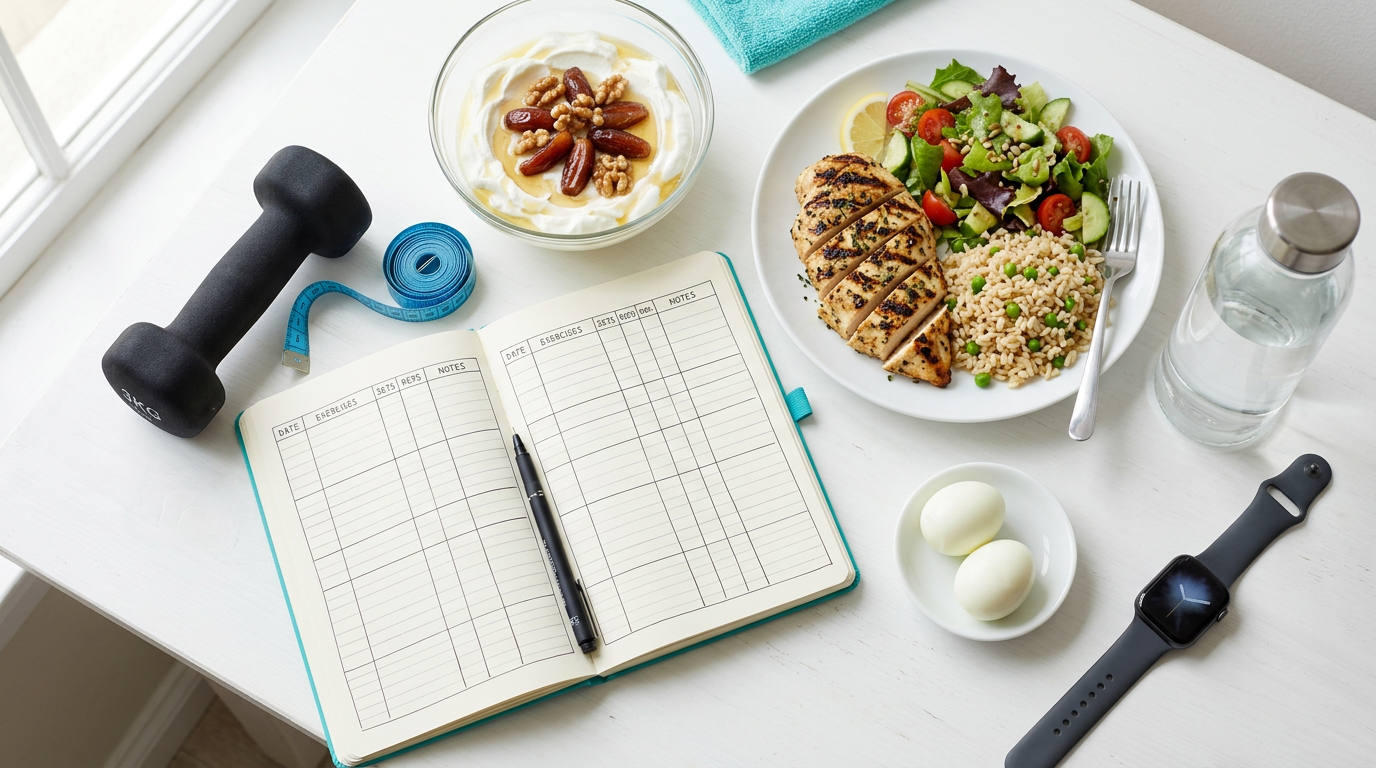
7 common reasons muscle growth stalls
1) You are not progressing the load
Muscle grows when it is asked to do more than it is used to. If you have lifted the same weights for the same reps for two months, there is no new reason to grow. The fix is simple: log your sessions, and when you reach the top of your rep range (for example 12) with good form, add a small amount of weight (about 2.5 kg) and restart at the bottom of the range (for example 8). We covered this in our guide How many sets and reps build muscle?
2) Weekly volume is too low or too high
Volume means the hard sets you do per muscle per week. A systematic review with meta-analysis concluded that training close enough to failure, paired with an adequate set volume of roughly 12 to 20 sets per muscle group per week on average, are key determinants of hypertrophy. (Refalo et al., 2023) Dose-response work (Pelland et al., preprint) links higher weekly volume with more growth in general, but the relationship is not a straight line, so doubling your sets does not double your results. If you do 4 sets per muscle, add gradually; if you do 25 and feel wrecked, trim.
3) You stop far from failure
Many people end a set while still able to do ten more reps. Aim to finish most sets with one to three reps left in reserve. The same meta-analysis found no evidence that going to complete failure on every set beats stopping a little short for muscle growth, so you do not need to drain yourself on every set, especially on heavy compound lifts.
4) Protein or calories are too low
Muscle needs raw material. In an analysis of 49 studies and 1,863 participants, protein supplementation improved gains in fat-free mass and strength during resistance training, and gains did not increase further beyond about 1.6 g per kg of body weight per day. (Morton et al., 2018) A later review of 74 trials found the effect in adults under 65 eating 1.6 g/kg or more alongside resistance training, though the effect was small and the certainty of evidence moderate. (Nunes et al., 2022) In practice, a 75 kg person is aiming for roughly 120 g per day. And if you are in a steep calorie deficit on a diet, building muscle is hard, so stay realistic.
5) Sleep and recovery are weak
Muscle is built during rest, not in the gym. Repeated late nights and short sleep reduce workout quality, raise hunger and slow recovery. Read our guide Sleep and Muscle Growth and start by fixing your bedtime and wake time for two weeks.
6) You change programs every two weeks or miss sessions
Jumping between programs stops you from measuring progress, and frequent missed sessions quietly reduce your real volume week after week. Pick a simple program and stick with it for eight to twelve weeks before changing it, and train three to four fixed days a week instead of six scattered ones.
7) Accumulated fatigue with no easy week
If you feel constantly heavy, your performance is dropping and motivation is low, you may need a lighter week. Read Deload Weeks: when you need one and how to do it. If muscle soreness follows you everywhere, see our guide to muscle soreness after workouts.
A 4-week plan to break the plateau
This is a general plan for a healthy person training three to four days a week. Adjust the weights to your level and stop if you feel sharp pain.
- Week 1: measure and log. Write down the weights and reps of your main lifts, and take measurements and photos. Use 10 to 12 sets per muscle and finish sets with two or three reps in reserve.
- Week 2: add reps. Keep the weights and try to add one or two reps per set. Raise volume to 12 to 14 sets and check you are reaching about 1.6 g of protein per kg.
- Week 3: add load. When you reach the top of the range, add a little weight, bring your sets closer to failure (one or two reps in reserve), and use 14 to 16 sets only for lagging muscles.
- Week 4: ease off, then retest. Cut sets by about 40% and keep the weights light to moderate, sleep as close to eight hours as you can, then repeat your measurements and photos and compare them with week 1.
Protein examples from our kitchen
- Grilled chicken breast, 100 g: about 30 g of protein.
- Two boiled eggs: about 12 g.
- A tub of Greek yogurt (170 g): about 15 to 17 g.
- A small drained can of tuna: about 20 to 25 g.
- A cup of cooked lentils: about 18 g.
These are approximate values that vary by brand and cooking method, so read the nutrition label.
Mistakes that delay a breakthrough
- Relying on the scale alone without measurements and photos.
- Lifting heavy with sloppy form just to hit a number: quality comes before load.
- Adding lots of cardio while eating very little at the same time.
- Buying many supplements instead of fixing the basics: training, food and sleep.
- Comparing yourself with people whose substances or circumstances are not yours.
When to talk to a professional
See a doctor or qualified professional if you have persistent joint or back pain, dizziness or shortness of breath during exercise, unexplained weight loss, chronic conditions such as diabetes or kidney disease, or if you take medication. High protein intake does not suit everyone with kidney disease, so ask your specialist first. This article is general educational information and does not replace personal medical advice.
Quick answers
- How long does a plateau usually last? It varies, but most people break through within four to eight weeks once volume, protein and sleep are fixed.
- Do I need supplements? Not everyone does. Food is the foundation, and supplements may help fill a daily protein gap after speaking with a specialist.
- Should I train every day to break a plateau? No. More days without recovery can deepen the plateau. Three to four well-planned days beat six exhausted ones.
Start your plan with Prof Health
Want a plan that fits your body and schedule without guesswork? Join the 30-Day Challenge by Prof Health, where specialists follow you in nutrition, fitness and mental wellbeing, or book a personalised consultation with The Professor over Zoom to set your protein needs and a training and nutrition plan that matches your goal.
Sources
- Influence of Resistance Training Proximity-to-Failure on Skeletal Muscle Hypertrophy (Sports Medicine, 2023) – proximity to failure and weekly volume.
- Protein supplementation and resistance training-induced gains (British Journal of Sports Medicine, 2018) – protein and the 1.6 g/kg ceiling.
- Protein intake to support muscle mass and function in healthy adults (2022) – systematic review of 74 trials.
- The Resistance Training Dose-Response (SportRxiv preprint) – weekly volume and frequency.