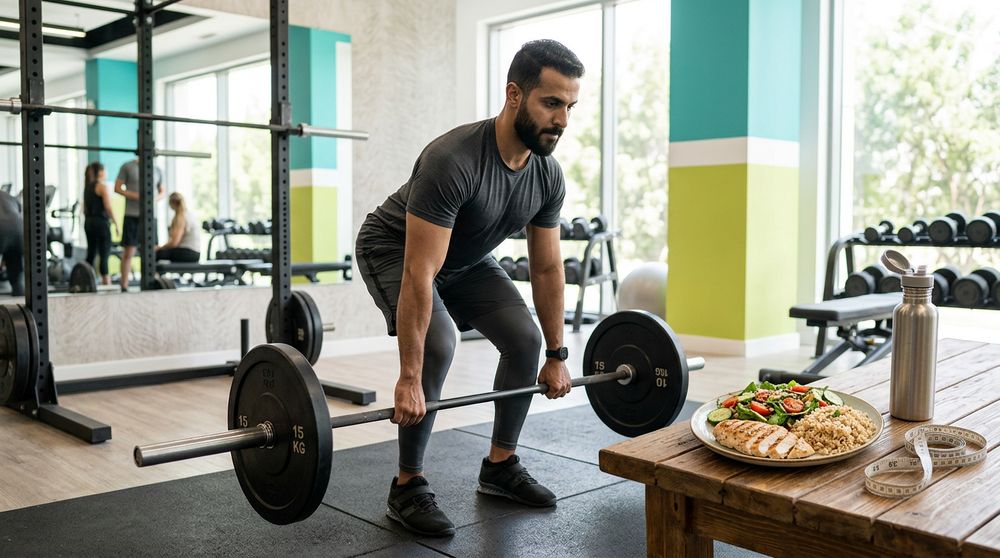
Body Recomposition: Can You Lose Fat and Build Muscle at the Same Time? Protein, Calories and an 8-Week Plan
Last updated: November 28, 2026
Quick answer
Yes, you can lose fat and build muscle over the same period, but only under clear conditions: progressive resistance training, enough protein (about 1.6 to 2.4 grams per kilogram of body weight a day) and a moderate calorie deficit of roughly 10 to 20% below maintenance. Results are largest in beginners and people with more body fat, smaller in lean trained lifters, and the scale may barely move while your shape changes. Track your waist, your strength and photos, not body weight alone.
You stand in front of the mirror and wonder: should you lose fat first and build muscle later, or the other way around? For years people said combining both goals was impossible and that you had to choose between "bulking" and "cutting." The truth is more nuanced. This process is called body recomposition, and it means a drop in fat mass and a gain in muscle mass over the same period. In this guide we explain how it works, who benefits most, how much protein and how many calories you need, how to structure your training and meals, and then give you a practical 8-week plan built for daily life in Riyadh.

What does body recomposition actually mean?
The scientific definition is simple: an increase in fat-free mass (mostly muscle) together with a decrease in fat mass within the same intervention period. Fat does not turn into muscle. They are different tissues that respond to different signals. Muscle responds to progressive loading with enough protein, while fat responds to an energy shortfall. Because both happen together, the number on the scale can stay close to where it was while your waist shrinks and your strength rises. That is why many people complain that their weight is stuck when they are in fact improving.
It also helps to know that your body does not work on an either-build-or-burn basis across the week. After a protein-rich meal and a good workout, muscle protein synthesis stays elevated for hours, and between meals and through the rest of the day your body draws on stored energy, including fat. What decides the outcome is the bigger picture over weeks, not a single day.
What does the research say?
A broad 2026 review of randomised trials and meta-analyses concluded that recomposition is feasible when three elements are combined: progressive resistance training, relatively high protein intake and a suitable energy prescription. According to the review, the most consistent protein intake across studies is about 1.6 to 2.4 g/kg a day, with higher relative intakes during an energy deficit or when you are already lean. It also noted that changes are largest in beginners and people with higher body fat, and smaller but still possible in trained, lean and older adults with careful programming.
An earlier review in the Strength and Conditioning Journal (NSCA, 2020) found that many randomised trials have shown recomposition even in resistance-trained people, and that lifting combined with adequate protein is the key factor. One frequently cited study is the 2016 McMaster University trial: young men trained six days a week in a large calorie deficit for 4 weeks, and the high-protein group (2.4 g/kg) gained about 1.2 kg of lean mass and lost about 4.8 kg of fat, while the lower-protein group only maintained lean mass. This does not mean you should copy a deficit that size. It was a short, fully supervised trial, but it shows how powerful protein plus training can be.
Who benefits the most?
- Beginners: any new resistance programme triggers a strong response, so you can often build muscle and lose fat at a fairly quick pace in the first months.
- People with extra body fat: stored fat provides energy that supports muscle growth even in a small deficit.
- People returning after a break: muscle "remembers" earlier training and comes back faster than it was first built.
- Advanced and lean lifters: still possible, but slower, and details matter: a very small deficit, high protein and good sleep.
The four pillars of success
1) Progressive resistance training
Muscle does not grow because you get tired. It grows because you give it a reason to adapt. That means gradually adding weight, reps or sets while keeping good technique. Train 3 to 4 days a week, build most of your programme around compound lifts such as squats, Romanian deadlifts, bench press, rows and overhead press, and finish most sets with one to three reps left in the tank. For the details, read our guide to progressive overload and the double-progression system.
2) Enough protein, spread across the day
Your practical target is 1.6 to 2.2 grams per kilogram of body weight a day, moving toward the upper end if you are lean or in a bigger deficit. Spread it over 3 to 5 meals at roughly 0.3 to 0.5 g/kg per meal. For exact numbers see our daily protein guide. Example: for an 80 kg person the target is about 130 to 175 grams a day, or roughly 35 to 40 grams at each main meal.
3) A moderate calorie deficit, not an aggressive one
The recent review suggests a deficit of about 10 to 20% below maintenance, and no more than about 0.5 to 0.7% of body weight lost per week if you are trained, while a beginner with more body fat can go a little faster at the start. If your maintenance is 2,500 calories, a suitable range is around 2,000 to 2,250. Starving yourself or running a large deficit pushes the body toward losing muscle, weakens your training and raises the odds of a crash after a few weeks.
4) Sleep, daily movement and recovery
Short sleep increases hunger, slows recovery and lowers training quality, and it is among the most neglected factors. Aim for 7 to 9 hours and check our sleep and muscle growth guide. Add daily walking of 7,000 to 10,000 steps, because it raises energy burn without draining recovery the way hard cardio can.
Want a plan that fits your body and goal precisely?
With the Prof Health 30-Day Challenge, 3 specialists follow you across nutrition, fitness and mindset, or book an online consultation with the Professor to set your calories, protein and training programme for body recomposition.
Discover the 30-Day ChallengeBook your consultationHow to build your daily plate
You do not need exotic meals. Build each meal around a protein source, then add vegetables and sensible portions of carbohydrates. Simple Saudi-friendly ideas:
- Breakfast: eggs with light-oil foul and whole-wheat bread, or Greek yogurt with oats and one date.
- Lunch: grilled chicken breast or fish with basmati rice (about one cooked cup) and a large salad.
- Pre-workout: a banana with cottage cheese or laban, or a tuna sandwich on whole-wheat bread.
- Post-workout: a protein meal or shake with fruit, then a full meal within two hours.
- Dinner: lentils or chickpeas with vegetables and lean minced meat, or a vegetable omelette.
Keep carbohydrates slightly higher on training days and lower on rest days, which supports performance without changing the weekly balance. For more on timing, see what to eat before and after a workout.
A practical 8-week plan
This plan is for healthy beginners and intermediates. Estimate your maintenance calories first, then subtract 10 to 15% for the first four weeks, and raise slightly if performance drops.
| Area | Weeks 1 to 4 | Weeks 5 to 8 |
|---|---|---|
| Weight training | 3 days, full body, 3 sets per exercise | 4 days, upper/lower, 3 to 4 sets |
| Reps | 8 to 12 with 2 to 3 reps in reserve | 6 to 12 with 1 to 2 reps in reserve |
| Movement and cardio | 7,000 steps + one easy 30-minute session | 8,000 to 10,000 steps + two easy sessions |
| Protein | 1.6 g/kg | 1.8 to 2.2 g/kg |
| Calories | 10 to 15% below maintenance | 10 to 20% below maintenance |
| Sleep | At least 7 hours | 7 to 9 hours |
Each week, log your lifts (weights and reps), measure your waist in the morning under the same conditions, and take a 7-day average of your weight. In week 4 and week 8, lower your loads a little to recover. If you combine cardio and weights on the same day, read how to combine cardio and weights without losing progress.
How do you know you are progressing?
Do not rely on the scale alone, since it cannot tell fat, muscle and water apart. Watch these markers together:
- Waist circumference: a falling waist with a steady weight is an excellent sign.
- Strength: more weight or reps on your key lifts.
- Photos: every two weeks, same light and pose.
- Clothes and energy: a better fit, more energy and better sleep.
You may need 4 to 8 weeks before the difference is clearly visible, and it is fine if numbers move slowly. If your strength drops for several weeks in a row while your weight falls fast, the deficit is too large and calories need to go up.
Common mistakes that slow results
- A deficit that is too big: raises the risk of muscle loss and weakens performance.
- Neglecting protein: without it, this becomes general weight loss.
- Changing the programme every week: progress needs repetition and tracking.
- Too much cardio: drains recovery and lowers the quality of your lifting.
- Judging by the scale only: causes needless frustration.
- Short sleep: hits hunger and recovery together.
Frequently Asked Questions About Body Recomposition
Can I do it if I have trained for years?
Yes, but at a slower pace. Experienced lifters need a small deficit, high protein, precise progressive loading and good sleep, and changes are usually smaller than in beginners.
Is bulking then cutting better?
Not necessarily. For beginners and people with extra body fat, recomposition is often enough. A lean advanced lifter who wants the maximum possible muscle may prefer a small surplus phase followed by a fat-loss phase.
How long will it take?
Strength markers move within weeks, while photos and measurements show change after 4 to 8 weeks. Judge monthly, not daily.
Do I need supplements?
No. Protein from food is the foundation. A protein powder can help you reach your daily target and creatine has good evidence too, but any supplement is a decision to review with a professional.
Is this approach right for everyone?
No. Pregnant or breastfeeding women and people with kidney disease, diabetes, eating disorders or certain medications need medical supervision before changing protein or calories.
Note:
This article is for health education and does not replace advice from your doctor, dietitian or certified trainer, especially if you have an injury, a health condition or take medication. Figures are approximate and vary from person to person.