Sleep and Muscle Growth: How Many Hours Do You Really Need to Recover and Build Muscle? A Practical Guide and Evening Routine
You can train perfectly, eat enough protein and still stall if you sleep five hours a night. Muscle is not built in the gym; the workout is only the signal. The building happens afterwards, during recovery, and sleep is the longest and most powerful recovery window you have. The practical takeaway: aim for roughly seven to nine hours in bed, keep your sleep and wake times consistent, protect the nights before your hardest sessions, and treat sleep as part of your training plan rather than a bonus.
At Prof Health we often hear: "I train four days a week and eat well, so why are my results slow?" When we look at the full day, the missing piece is very often late nights, scrolling in bed, heavy evening caffeine and irregular sleep. In this guide we explain what sleep does for muscle, what the studies actually show (and where the evidence is still limited), how many hours you need, and a simple evening routine that fits life in Riyadh.
Why muscle grows while you rest, not while you lift
Resistance training creates a stimulus: muscle fibres are stressed, and the body responds by repairing and reinforcing them, which over weeks leads to more muscle and strength. That response depends on muscle protein synthesis, the process of building new muscle protein from the amino acids you eat. Three things support it: enough training stimulus, enough protein and calories, and enough recovery. Sleep sits inside that third pillar, and it affects the first two as well, because a tired person trains with less intensity and eats with less control.
During sleep your body also regulates hormones such as growth hormone, cortisol and testosterone, and it manages inflammation and energy balance. Researchers are still working out exactly how each of these contributes to muscle gain, so we should avoid promising a magic number. What we can say with confidence is that short sleep tends to push things in the wrong direction: lower training quality, higher hunger, slower recovery and a poorer environment for building muscle.
What the studies show
The research on sleep and muscle is growing, and it is worth being precise about what each study tested.
- One night without sleep. In a controlled crossover study of 13 healthy young adults, a single night of total sleep deprivation reduced muscle protein synthesis by about 18%, raised cortisol by about 21% and lowered testosterone by about 24% the next day. The authors describe this as an anabolic-resistant, pro-catabolic state. (Lamon et al., 2021) Keep in mind this was an extreme condition with a small sample.
- Five nights of four hours in bed. In a trial of 24 young men, those restricted to four hours a night had lower rates of myofibrillar protein synthesis than the group sleeping eight hours. A group that did three high-intensity interval sessions during the same restricted week kept their rates at control levels, which suggests exercise can partly protect muscle when sleep is short. (Saner et al., 2020) This does not mean you can replace sleep with exercise; it shows that training still matters on bad weeks.
- Strength performance. A systematic review concluded that sleep deprivation or restriction can reduce maximal strength in compound lifts, particularly when motivation is not boosted by competition or encouragement, while findings on testosterone and cortisol responses to training were mixed. (Knowles et al., 2018)
So the honest summary is this: short sleep reduces the signals that build muscle and lowers the quality of your sessions, but most of the strongest data come from short-term experiments in young, healthy people. Long-term effects in different groups, including women and older adults, still need more research. The direction of the evidence is clear enough to act on without overstating it.
How many hours do you actually need?
There is no single number that fits everyone, but most healthy adults function best with about seven to nine hours of sleep. If you are in a hard training block, recovering from illness or training early in the morning, you will usually sit toward the upper end. Use these practical signals rather than guessing:
Signal | What it may mean | What to try |
|---|---|---|
You wake up unrefreshed even after 7 hours | Poor sleep quality or an irregular schedule | Fix wake time first, cut late caffeine, darken the room |
Your usual weights suddenly feel heavy | Accumulated fatigue or short sleep | Add a night of earlier bedtime, reduce volume for a few days |
Soreness lasts much longer than usual | Recovery is lagging | Check sleep, protein and total weekly volume |
Strong cravings for sugar late at night | Short sleep can raise appetite | Plan a protein-rich evening snack and an earlier wind-down |
Seven sleep habits that support muscle gain
- Keep a fixed wake-up time. A consistent wake time anchors your body clock more than a perfect bedtime does. Keep it within about an hour, including weekends.
- Stop caffeine about eight hours before bed. Caffeine stays in the body for hours. If you go to bed at 11 pm, your last coffee or pre-workout should be mid-afternoon. Many pre-workout powders contain a lot of caffeine, so check the label.
- Get morning light. A few minutes of daylight after waking helps set your body clock. We explain this in our guide on morning light and your body clock.
- Finish hard training at least two to three hours before bed. Some people sleep fine after evening sessions, but if you struggle, move intense work earlier and keep late sessions lighter.
- Eat a protein-rich dinner and a light evening snack. Greek yogurt, laban, eggs or cottage cheese with a few dates work well. Avoid very heavy, spicy or very late meals if they disturb you.
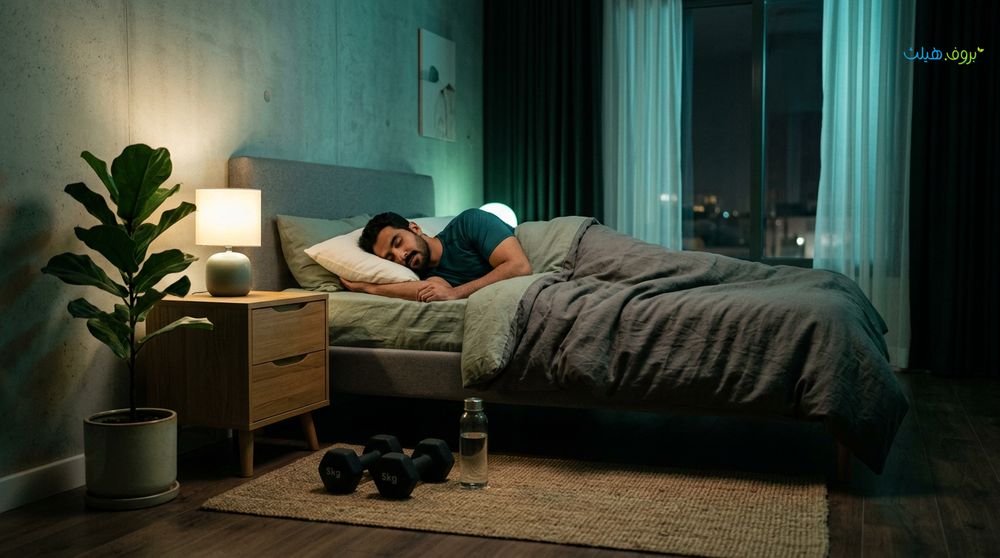
- Cool, dark and quiet room. In Riyadh's summer a slightly cooler room, blackout curtains and a fan make a real difference. Aim for a comfortable cool temperature rather than a freezing one.
- Screens down, wind-down on. Give yourself 30 to 45 minutes without work messages or social media. Light stretching, a warm shower, reading or a short breathing routine all help.
A simple evening routine you can start tonight
- 9:00 pm: last caffeine long gone; finish dinner or a light protein snack, and drink water steadily, not in one large glass at bedtime.
- 9:30 pm: prepare tomorrow: gym bag, breakfast, a short to-do list so your mind is not busy in bed.
- 10:00 pm: phone away from the bed, dim lights, five minutes of gentle stretching for hips, hamstrings and shoulders.
- 10:30 pm: in bed, cool and dark room. If you do not fall asleep within about twenty minutes, get up, do something quiet in dim light, and return when sleepy.
Adjust the times to your schedule. What matters is the sequence and repeating it, because your body learns the cues.
What if you had a bad night before a workout?
Do not panic and do not necessarily skip. After one poor night you can usually still train, but treat it as a lighter day: keep your usual exercises, reduce the number of sets by about a third, leave a couple of repetitions in reserve and avoid testing new maximums. If you slept very little for several nights in a row, or you feel dizzy or unusually exhausted, choose walking or mobility work and sleep earlier. Our guide on deload weeks explains how to lower training stress on purpose, and our article on muscle soreness and recovery covers the other recovery tools.
Remember that your weekly plan matters more than any single session. If you are unsure how many sets you need, our guide to sets, reps and weekly volume gives you a starting point that you can scale up or down depending on how you are sleeping.
Common mistakes that quietly cost you muscle
- Cutting sleep to fit in more training. Beyond a point, another hour of training does less than another hour of sleep.
- Sleeping late on days off, then trying to fix it with caffeine on Sunday and Monday.
- Using heavy pre-workout or energy drinks in the evening.
- Under-eating protein and calories, which makes recovery harder even if you sleep well.
- Ignoring snoring, gasping at night or extreme daytime sleepiness, which can signal a sleep disorder such as sleep apnoea.
- Relying on sleep supplements without medical advice. Speak to your doctor or pharmacist first, especially if you take other medication.
When to talk to a doctor
If you have trouble sleeping for more than a few weeks, snore loudly, stop breathing during sleep, wake with headaches, feel very sleepy during the day, or notice persistent low mood or anxiety, speak to a doctor. These problems affect health far beyond the gym, and they are treatable. This article is general educational information and does not replace personal medical advice.
Quick answers
- Can I build muscle on six hours of sleep? You can still progress, but you will probably progress more slowly and feel worse. If six hours is your reality for now, protect consistency, protein and training quality, and work on adding thirty minutes.
- Do naps help? A short nap of 20 to 30 minutes early in the afternoon can help recovery for many people, but it should not push your night sleep too late.
- Is it better to sleep or to train when I am tired? One short session is usually fine at lower volume; a pattern of chronic sleep loss is a signal to fix sleep first.
Sources
- The effect of acute sleep deprivation on skeletal muscle protein synthesis and the hormonal environment (Physiological Reports, 2021) – one night of total sleep loss and muscle protein synthesis.
- The effect of sleep restriction, with or without high-intensity interval exercise, on myofibrillar protein synthesis in healthy young men (Journal of Physiology, 2020) – five nights of restricted sleep.
- Inadequate sleep and muscle strength: Implications for resistance training (Journal of Science and Medicine in Sport, 2018) – systematic review on strength performance.
Read also
- Morning light and your body clock
- Deload weeks: when you need one
- Muscle soreness after training: 7 recovery tips
Ready for the next step with Prof Health?
If you want training, nutrition and sleep habits organised in one plan, try the 30-Day Challenge by Prof Health, where specialists follow you in nutrition, fitness and mental wellbeing, or book a personalised consultation with The Professor over Zoom to set your protein needs and a plan that fits your body and your schedule. Start tonight with an earlier bedtime and take the first step.