Can Ab Exercises Burn Belly Fat? The Truth About Spot Reduction and a Practical 4-Week Plan
Quick answer: you cannot choose where your body burns fat. Ab exercises strengthen the trunk muscles and improve stability and posture, but on their own they do not reliably melt belly fat. The strongest evidence points to overall lifestyle: regular physical activity, full-body resistance training, a balanced diet and enough sleep. A few small recent studies show promising results when ab work is combined with aerobic exercise, but they are still early and do not change the practical rule.
Many people ask us at Prof Health the same question: "I do a hundred crunches every day, so why is my waist not getting smaller?" The answer is that the body does not work that way. In this guide we explain the idea of spot reduction, what studies honestly say (including the conflicting results), why belly fat can feel stubborn, what ab exercises are genuinely good for, and then we give you a practical four-week plan for training, walking and nutrition, with tips for exercising in Riyadh's climate.
What is spot reduction, and why does the belief persist?
Spot reduction is the idea that training a specific muscle burns the fat sitting directly above it: crunches melt belly fat, triceps exercises slim the arms. The belief spreads because it sounds logical. We feel the burn in the muscle and assume the fat is burning there. But that burning sensation comes from the effort inside the muscle fibres, not from the nearby fat melting away.
What actually happens is that the body draws energy from fat stores in many places, and that fat travels through the blood to fuel the working muscles wherever they are. That is why researchers at the University of Sydney explain that the fat stores we use for energy come from all over the body, not just the belly, and that the results people want in a specific area come from targeting overall fat loss.
What do the studies say? The full picture
Scientific honesty means showing the whole picture, because this topic has been debated for decades:
- Most evidence does not support spot reduction: a 12-week randomised trial compared people who added abdominal resistance exercises to a diet change with people who only changed their diet. It found no greater belly-fat improvement in the ab-exercise group.
- Some newer studies found different results: in a 10-week randomised trial of 16 overweight men (average age 43), trunk fat fell more in the group that combined treadmill running with torso rotation and ab exercises than in a group that only ran, with energy expenditure matched. Total fat mass and body weight fell similarly in both groups.
- A small circuit-training study: an 8-week trial with 14 volunteers suggested that a circuit protocol combining abdominal and triceps work with aerobic exercise reduced subcutaneous fat in the abdominal area.
How should we read this? The newer studies are small, mostly in specific adult groups, and have not yet been widely replicated. We treat them as promising hypotheses worth watching, not promises to build a plan on. The safe practical rule: build your programme on overall fat loss and muscle gain, and treat ab work as a useful addition, not a replacement.
Why does belly fat feel so stubborn?
- Genetics: bodies differ in where fat is stored first and lost last, largely determined by heredity.
- Two kinds of belly fat: subcutaneous fat under the skin that you can pinch, and visceral fat deep around the internal organs. Visceral fat is linked with higher health risks such as diabetes and high blood pressure, which is why waist health matters beyond appearance.
- Sleep and stress: poor sleep and chronic stress influence appetite and food choices, making weight loss harder.
- Long sitting hours: hours at a desk cut daily energy expenditure no matter how short your workout is.
So what are ab exercises good for?
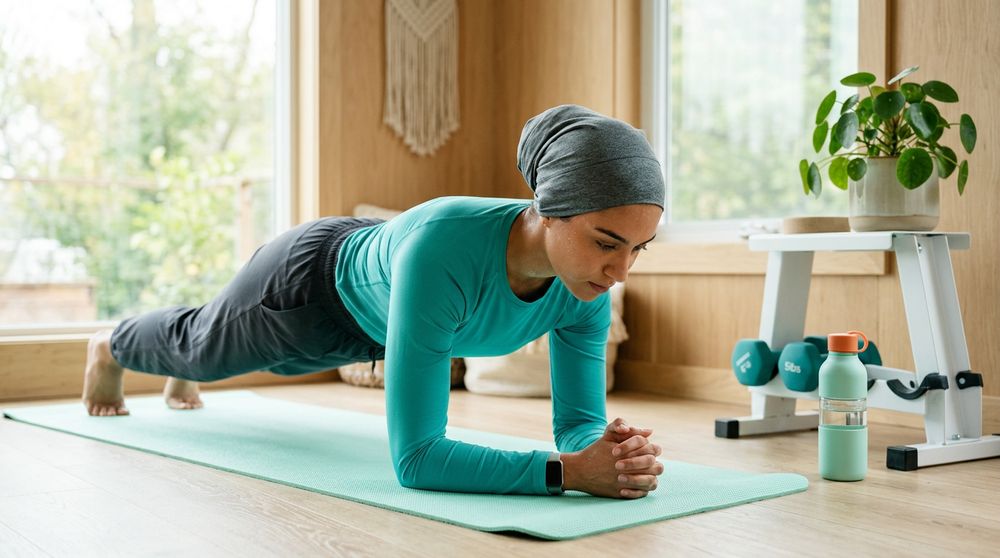
Do not give up ab work, but know its real job. A strong trunk protects the lower back, improves posture and stability, helps you lift more in squats, deadlifts and pressing movements, and reduces discomfort during long sitting. Stronger muscles can also improve the look of your waist over time once overall body fat comes down. Choose varied exercises instead of endless crunches: planks, dead bugs, bird dogs, side planks and the Pallof press with a resistance band. For more ideas read our guide to core training beyond crunches.
A 4-week plan for a slimmer waist and a stronger core
The plan suits beginners and people returning to exercise. Start at a level that fits your fitness, reduce the intensity if you feel unusual pain, and talk to your doctor first if you have a health condition.
Week | Resistance training (3 days) | Cardio and walking | Core (2 days) |
|---|---|---|---|
1 | 30-minute full-body session: squats, pushes, band rows, dumbbell work. 2 sets of 10 reps | 7,000 steps a day + 20 minutes of brisk walking on two days | Plank 3 x 20 seconds, dead bug 2 x 8 |
2 | Same session with 3 sets; add a little load if reps feel easy | 8,000 steps + 25 minutes of brisk walking on three days | Plank 3 x 30 seconds, bird dog 2 x 10 |
3 | Add a back and glute exercise (dumbbell Romanian deadlift); keep 3 sets | 8,000 to 9,000 steps + walking intervals (2 minutes fast, 2 minutes easy x 6) | Side plank 3 x 20 seconds per side, Pallof press 2 x 10 |
4 | Increase load or reps gradually, with one minute of rest between sets | 9,000 steps + 30 minutes of moderate cardio twice | Plank 3 x 40 seconds, dead bug 3 x 10 |
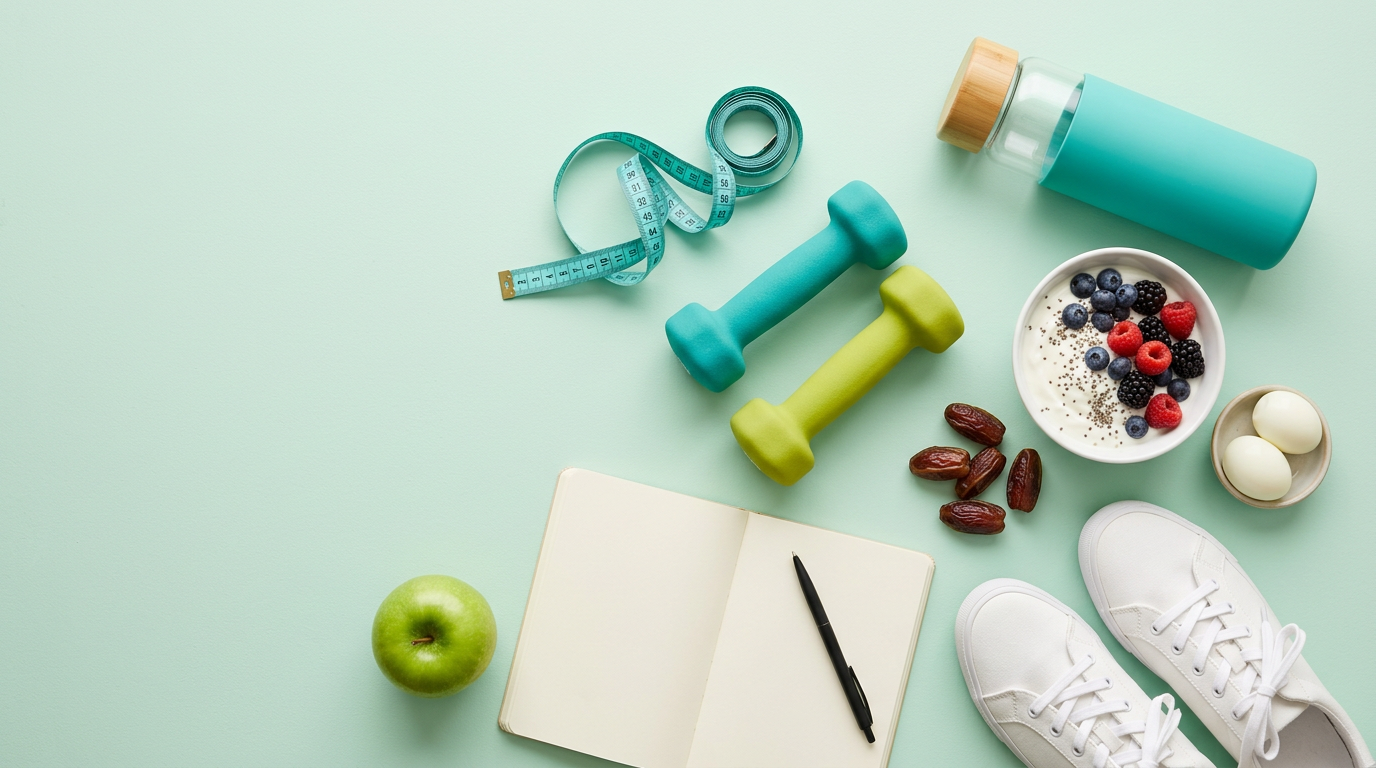
Three rules run through the whole plan: increase the load gradually (see our progressive overload guide), write your workouts in a notebook, and measure your waist with a tape every two weeks at the same time of day, because the scale alone does not tell the full story when you are gaining muscle and losing fat. For walking, read our daily steps guide. The World Health Organization recommends at least 150 minutes of moderate-intensity physical activity per week for adults, a good starting point that this plan covers.
Nutrition and sleep: half of the equation
- Protein at every main meal: eggs, Greek yogurt, chicken, fish or legumes increase fullness and support muscle while you lose fat.
- Fibre and vegetables: fill half your plate with vegetables and salads, and add legumes and whole grains.
- Sugary drinks: juices, soft drinks and sweetened coffee are easy sources of calories that do not fill you up; swap them for water, tea and unsweetened coffee.
- Dates in moderation: three dates after training is a sensible choice, but a large portion still counts toward your calories.
- Sleep: seven hours or more is commonly recommended for adults; good sleep regulates appetite and improves recovery.
If you are wondering about supplements, there is no proven "belly fat burner". University of Sydney researchers reviewed data from more than 120 placebo-controlled trials of herbal and dietary supplements and found none that produced a clinically meaningful reduction in body weight in people with overweight or obesity. For details read protein supplements: myths and facts.
Training in Riyadh: heat, timing and place
In the hot months choose early morning or after sunset for outdoor walks, or move them to the mall or a treadmill. Drink water before and after exercise and wear light, breathable clothing. At home, a small corner with a mat, dumbbells and a resistance band is enough to complete the whole plan.
Common mistakes that slow your progress
- Relying on hundreds of daily crunches while neglecting full-body training and walking.
- Comparing yourself with edited social media photos or with someone whose genetics are different.
- Skipping food after training or cutting protein, so you lose muscle instead of fat.
- Trusting the scale only and ignoring waist measurements, progress photos and gym performance.
- Going all out in week one and then quitting; consistency matters more than intensity.
- Buying "belly fat burning" products and heat belts that have no evidence behind them.
When to see a doctor
Talk to your doctor before starting a new programme if you have heart disease, diabetes, high blood pressure or joint pain, or if you are pregnant or postpartum. Also seek advice if you notice sudden abdominal swelling, persistent pain or unexplained weight change, which may be caused by a medical condition that exercise will not fix.
Quick summary
- You cannot choose where fat is lost; your body and genetics decide.
- Ab exercises strengthen the trunk and improve posture, but they are not a guaranteed way to melt belly fat.
- The foundation: three resistance sessions, daily walking, protein and vegetables, and enough sleep.
- Measure your waist every two weeks and do not rely on the scale alone.
- Small recent studies are promising but not enough to build promises on.
Frequently asked questions
How many ab exercises do I need each day? Two to three good-quality sessions a week are enough; more will not burn extra fat.
Is it different for men and women? The spot reduction rule is the same, but fat distribution differs by sex, genetics, age and hormones.
When will I see results from the plan? Many people notice better strength and energy within weeks, while changes in the waist take months of consistency, and responses vary from person to person.
Is walking alone enough? It helps your health and calorie use, but adding resistance training protects muscle and improves body shape.
Sources
- University of Sydney: why targeting weight loss to a specific area is a myth — evidence overview and a 12-week trial.
- Randomised trial: abdominal endurance exercise and trunk fat loss — the recent study of 16 men.
- Mixed endurance and strength circuit training and regional fat thickness — a small 8-week study.
- World Health Organization: physical activity fact sheet — at least 150 minutes a week.
Read also
- Core training beyond crunches
- Steady cardio or HIIT: which is better for fat loss?
- Muscle soreness after workouts: 7 recovery tips
Ready for the next step with Prof Health?
If you want a plan that brings training, nutrition and psychological support together in one programme, try the 30-Day Challenge by Prof Health, with three specialists who follow you in nutrition, fitness and mental wellbeing, or book a personalised consultation with The Professor over Zoom to set your protein needs and a nutrition plan that fits your body and schedule. Start today; one session is enough to begin the journey.