
Headache in Ramadan: 5 Common Causes and How to Avoid It Before It Starts
Last updated: November 29, 2026
If the first-days-of-Ramadan headache comes back every year, start preparing before the month rather than after it begins. If you want a plan to start now, the Sha'ban & Ramadan Wellness Package is a 60-day program with 3 meal plans built around your taste, 4 workout plans and a Ramadan recipe booklet, while the Eid Package gives you daily follow-up for 3 months, from Rajab until Ramadan.
Is Headache in Ramadan Really Common?
Yes, and several studies have recorded it. In a Saudi study at the National Guard Hospital in Riyadh, hospital staff were surveyed on the second day of fasting: 41% of those who fasted (37 of 91) reported a headache, against 8% of those who did not (2 of 25). Most were tension-type (78%), and caffeine withdrawal was the most important external factor linked to them (Awada and al Jumah, Headache, 1999).
In a newer study in Frontiers in Neurology in 2026, covering 2,358 participants from 14 countries, 74.6% reported a headache while fasting in Ramadan 2023. Attacks were most common in the afternoon and before iftar, and improved after iftar in 54.6% of those who had them. Half of the participants were from Türkiye, so these figures should not be applied word for word to every country.
What Causes Headache in Ramadan?
The International Classification of Headache Disorders (ICHD-3) describes fasting headache as a headache that appears during fasting and eases after eating. A 2026 scoping review in Pain Management, covering 20 studies, lists dehydration, caffeine withdrawal, low blood sugar, disrupted sleep and eating habits as the main proposed mechanisms, with the effect clearest in the early days and easing afterwards. The five common causes are:
- Sudden caffeine withdrawal: from coffee, tea, soft drinks and energy drinks.
- Too little water: fasting lengthens the gap between drinks.
- Low blood sugar and changed meal times: especially after a light or sugary-only suhoor.
- Short sleep: from late nights and waking up for suhoor.
- Personal susceptibility: the multinational study found that people with a history of primary headache, especially migraine, were more likely to get headaches in Ramadan, and that food and drink factors often act as contributors rather than the only cause.
How Does Stopping Caffeine Cause a Headache?
According to Mayo Clinic, caffeine narrows the blood vessels around the brain. When you stop, those vessels widen, blood flow around the brain increases, and what is known as a caffeine withdrawal headache can appear. Mayo Clinic notes that withdrawal symptoms, including headache, tiredness and trouble focusing, are usually mild and improve after a few days, and that cutting back gradually softens them. In Ramadan caffeine stops for the whole daytime, so many people feel the headache around midday.

How Do You Cut Caffeine Before Ramadan?
- Count what you drink: track cups of coffee, tea, soft drinks and energy drinks for a week. Mayo Clinic says up to about 400 mg a day (roughly four cups of brewed coffee) appears safe for most adults.
- Cut back step by step: one cup fewer or a smaller size every few days instead of stopping at once, starting weeks before Ramadan. The Riyadh study's authors advised reducing caffeine gradually in the weeks before the month.
- Do not leave the last cup late: late caffeine can shorten sleep, and short sleep adds to headaches.
- Pregnant or breastfeeding: talk to your doctor about the right caffeine amount.
For a full preparation plan covering food, sleep, caffeine and water, read Diet Before Ramadan: How to Prepare Your Body for Fasting in 4 Weeks.
Want a ready schedule instead of trial and error?
The Sha'ban & Ramadan Wellness Package includes 3 meal plans built around your taste, 4 workout plans and a Ramadan recipe booklet over 60 days. The Eid Package gives you daily follow-up for 3 months, from Rajab until Ramadan.
What Kind of Suhoor Lowers the Chance of a Headache?
Since low blood sugar is one of the proposed mechanisms, aim for a balanced suhoor that does not spike your sugar and then drop it. A practical mix:
- Slow carbohydrates: oats, whole-grain bread or fava beans.
- Protein: eggs, milk or yogurt.
- Healthy fats: nuts or olive oil.
- Water: a glass or two with suhoor.
- As little as possible: salty, fried and sugary foods, because they increase thirst.
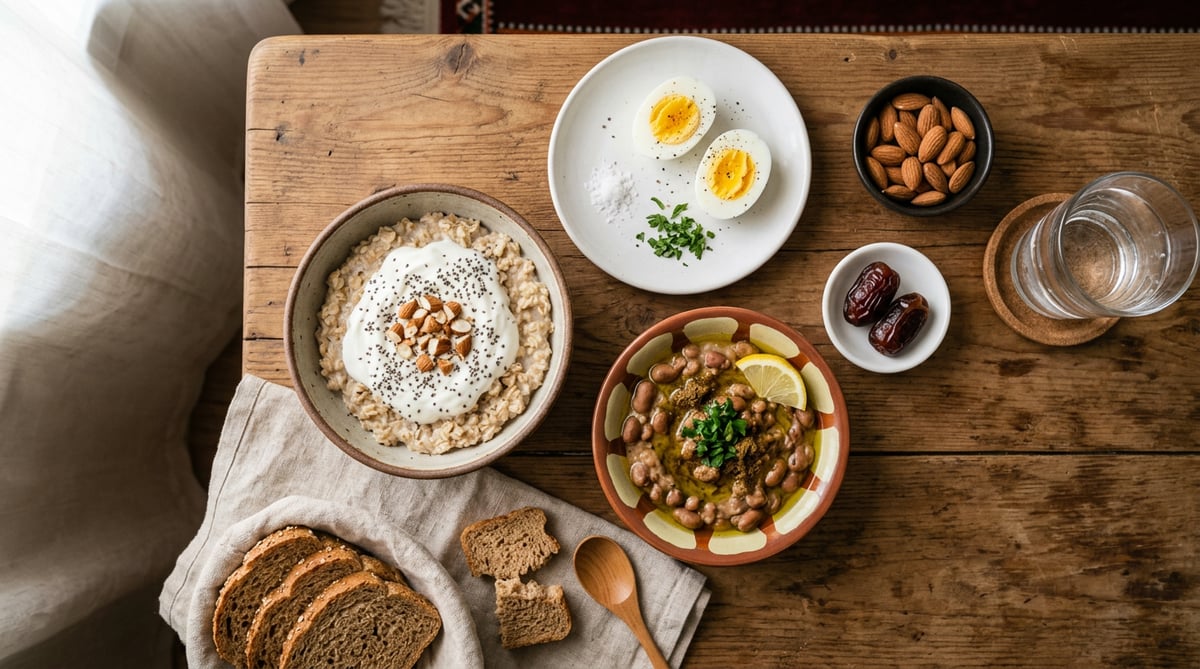
For more ideas read A Healthy, Filling Suhoor for Your Diet in Ramadan.
How Do You Spread Water Between Iftar and Suhoor?
Dehydration is also a proposed mechanism. It is best not to drink a large amount at once, but to spread it over small glasses between iftar and suhoor, starting with a glass alongside your dates at iftar. You will find a simple schedule in Drinking Water in Ramadan: A Simple Schedule.

What Role Do Iftar and Sleep Play?
Eat slowly at iftar: start with dates and water, then a balanced meal, and do not fill your stomach all at once. Mayo Clinic notes that small amounts of lost sleep add up and affect alertness the next day, so try to keep sleep hours close to usual, with a short nap if possible. For iftar, read A Healthy Iftar in Ramadan, and to organize your meals see A Ramadan Diet Schedule in 4 Phases.
When Is a Headache a Reason to See a Doctor?
Most fasting headaches ease with food and simple adjustments, but see your doctor or emergency care in any of these cases:
- A sudden, very severe headache, or the worst of your life.
- A headache with weakness, numbness, vision or speech changes, confusion or fever.
- A daily headache that continues after the first days despite adjusting suhoor, water and sleep.
- A headache if you have diabetes, high blood pressure or migraine, are pregnant, or take regular medication.
Do not stop a medicine or change its dose on your own, and ask your doctor about any medicine and its timing. If you want an eating pattern that fits your situation, you can book an online nutrition consultation over Zoom, or start a personalized diet plan. The service is 100% online and does not replace your doctor's follow-up.
What Should You Do Now Before Ramadan?
- Track your caffeine cups for a week, then reduce them gradually.
- Try a balanced suhoor for a week with slow carbohydrates, protein and healthy fats.
- Spread water over small glasses between iftar and suhoor.
- Read the Ramadan Healthy Diet Guide for the full picture.
- Build your schedule with the Sha'ban & Ramadan Wellness Package or choose longer follow-up with the Eid Package.
Start Ramadan with a balanced plan that fits you
Choose the program that suits you, and you can ask questions before subscribing.
Start the Sha'ban & Ramadan Package Join the Eid Package
Or book your consultation now or start the personalized diet plan.
Frequently Asked Questions
Why do I get a headache in the first days of Ramadan?
Usually because of a sudden change in caffeine, water, meal times and sleep. The effect is clearest in the early days and then eases for many people.
Does a fasting headache go away on its own?
Reviews indicate it usually eases after the first days, but if it continues daily or gets worse, see your doctor.
Does drinking coffee at suhoor prevent the headache?
The authors of the Riyadh study suggested a cup of coffee before the fast begins, together with reducing caffeine gradually before the month. But late caffeine can hurt sleep, so ask your doctor if you have a special condition.
Does too little water cause headaches?
Dehydration is one of the proposed mechanisms, so spread your water between iftar and suhoor instead of drinking it all at once.
Should I take a painkiller for the headache?
That is a medical decision. Ask your doctor or pharmacist about any medicine and its timing, and do not stop a medicine or change its dose on your own.
Will the Sha'ban & Ramadan Package help me?
The package organizes your food and movement over 60 days with 3 meal plans built around your taste, 4 workout plans and a recipe booklet, and it does not replace your doctor if you have frequent headaches.
Read Also
- Diet Before Ramadan: How to Prepare Your Body for Fasting in 4 Weeks
- Drinking Water in Ramadan: How Many Cups Between Iftar and Suhoor?
- A Healthy, Filling Suhoor for Your Diet in Ramadan
- Ramadan Healthy Diet Guide
Health note: This content is educational and does not replace medical advice. Do not stop a medicine or change its dose without checking with your doctor, and results differ from person to person.
References
- Fasting-induced headache in Ramadan: a scoping review — Makki G, Do TP, Pellesi L, Pain Management (2026) — https://pubmed.ncbi.nlm.nih.gov/42841395/
- The first-of-Ramadan headache — Awada A, al Jumah M, Headache (1999) — https://pubmed.ncbi.nlm.nih.gov/11279933/
- Primary headache disorders susceptibility is associated with fasting-related headache — Frontiers in Neurology (2026) — https://www.frontiersin.org/journals/neurology/articles/10.3389/fneur.2026.1859536/full
- Caffeine: How much is too much? — Mayo Clinic — https://www.mayoclinic.org/healthy-lifestyle/nutrition-and-healthy-eating/in-depth/caffeine/art-20045678
- Caffeine's effect on headaches — Mayo Clinic Health System — https://www.mayoclinichealthsystem.org/hometown-health/speaking-of-health/does-caffeine-treat-or-trigger-headaches