How Many Steps a Day Do You Really Need? 7,000 vs 10,000 and a Practical 4-Week Walking Plan
You probably do not need 10,000 steps to benefit. A 2025 systematic review in The Lancet Public Health reported that about 7,000 steps a day was associated with roughly 47% lower all-cause mortality compared with about 2,000 steps, and that benefits begin even at around 4,000 steps. 10,000 remains a good target if you are already active. The practical takeaway: start from your current average, add 1,000 steps each week, make part of your walking brisk, and add strength training twice a week.
Many people ask us at Prof Health: do I have to walk 10,000 steps every day to lose weight and protect my heart? And what if I have a desk job and Riyadh's weather does not exactly invite walking? The honest answer is that there is no magic number, and that any increase in daily movement beats staying seated. In this practical guide you will learn what recent studies say, how many steps suit your goal and age, how to judge walking intensity without complicated gadgets, a four-week plan that is easy to follow, and how to deal with heat and a busy schedule.
What do studies say about daily steps?
A recent systematic review pooled 57 studies from 35 cohorts and looked at the link between device-measured steps and health. It found that more steps were associated with better results across nearly every outcome studied. Compared with 2,000 steps a day, walking about 7,000 steps was associated with roughly 47% lower all-cause mortality, 25% lower cardiovascular disease, 14% lower type 2 diabetes, 38% lower dementia, 22% lower depressive symptoms and 28% fewer falls.
The researchers also noticed that the curve rises quickly at first and then flattens: the turning point for mortality and heart disease sits at roughly 5,000 to 7,000 steps. In other words, moving from a sedentary life to a moderately active one gives the biggest gain, and each step beyond that adds a little less, though it does no harm. Notably, even around 4,000 steps a day was linked to better outcomes than 2,000, so never dismiss a small goal.
These figures show association, not proof of cause. People who walk more may already be healthier, the number of studies for some outcomes is small, and the certainty of the evidence varies. So read the numbers as a general direction and a guide, not a guarantee.
Are 10,000 steps a magic number?
The figure spread decades ago as a marketing slogan more than as a research result. When researchers examined the evidence in a 2022 analysis of 15 international cohorts, they found that mortality risk falls progressively as steps rise, but only up to a point that depends on age: for adults aged 60 and over the benefit continued up to about 6,000 to 8,000 steps, and for younger adults up to about 8,000 to 10,000 steps.
So 10,000 steps is not wrong. It is a fitting ceiling for active younger adults or anyone who wants to raise their fitness. But if you are starting from zero, a 10,000-step target can kill your motivation in week one. A realistic goal you hit most days, raised gradually, works better.
How many steps suit your goal?
- General health and less sitting: 6,000 to 8,000 steps a day is an excellent target for most adults.
- Weight loss: start at 7,000 to 8,000 steps, then build gradually to 9,000 or 10,000 if it suits you, while managing food, because walking alone does not cancel an extra meal.
- Beginner or returning after a break: start from your current average and add only 1,000 steps each week, even if your average is 3,000.
- Older adults: 6,000 to 8,000 steps is usually enough, plus balance and strength work to lower the risk of falls.
- People with chronic conditions: agree a suitable target with your doctor before raising intensity.
Steps are not everything: what does the WHO recommend?
The World Health Organization recommends that adults do 150 to 300 minutes of moderate-intensity aerobic activity a week, or 75 to 150 minutes of vigorous activity, or an equivalent mix. It also recommends muscle-strengthening activities for all major muscle groups on two or more days a week. Brisk walking counts as moderate-intensity activity, and every minute counts regardless of session length. So 30 minutes on five days roughly meets the minimum, and strength work completes the picture.
This is where walking intensity matters. Try the talk test: if you can speak in full sentences while walking, your intensity is moderate and suitable; if you run out of breath before finishing a sentence, the intensity is high; and if you could sing comfortably, pick up the pace a little.
A 4-week walking plan
Check your average steps over the last three days on your phone or smartwatch, then follow this schedule. If your average is 3,000 steps, week one's target becomes 4,000, and so on.
- Week 1 (add 1,000 steps): walk 10 minutes after each main meal and take the stairs instead of the lift when you can. Do not worry about speed yet; the aim is to lock in the habit.
- Week 2 (add another 1,000): do one brisk 20-minute walk, and take phone calls standing or walking instead of sitting.
- Week 3: three brisk sessions of 25 to 30 minutes, plus two bodyweight strength days (squats, wall push-ups, glute bridges, planks) of 15 minutes.
- Week 4: settle your target at 7,000 to 8,000 steps, add a fourth, longer session (40 minutes) at the weekend, and keep one light rest day.
If you miss a day, do not try to make up for it the next day. The weekly average matters, not daily perfection.
Simple ways to add steps without extra time
- Park two minutes' walk from the mall entrance or your workplace.
- Stand up every 45 minutes and move for two minutes; this alone can add 1,500 to 2,000 steps a day.
- Use phone calls as walking time in the corridor or garden.
- Make a walk after dinner a family habit; it aids digestion and brings the family together.
- Set a visible small goal: the step ring on your smartwatch or a challenge with a friend or colleague.
Walking and weight loss: linking steps to food
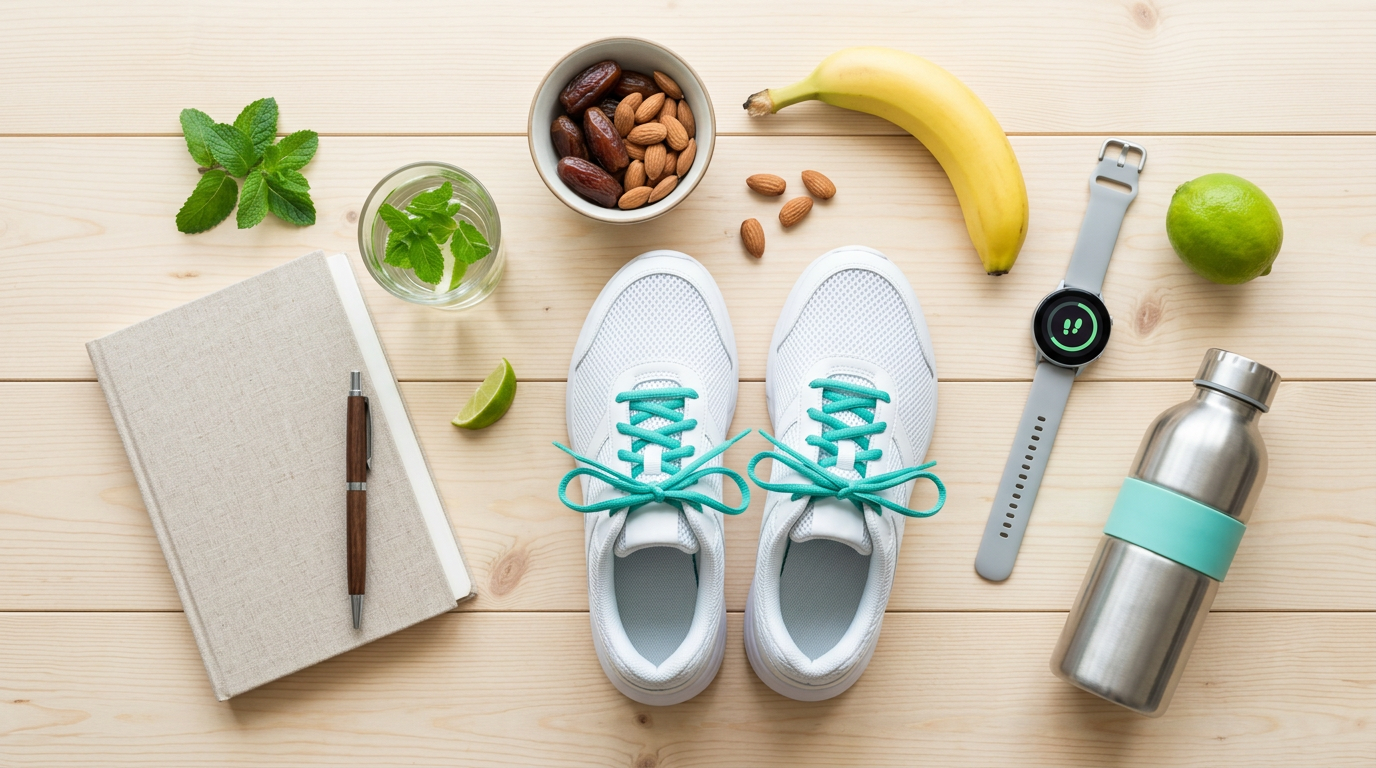
Walking burns calories, but fewer than many watches suggest, and it is easy for a feeling of having earned a treat to become an extra meal or drink that cancels the effect. So see walking as support for your nutrition plan, not a replacement. A balanced meal with protein, vegetables and fibre keeps you full and fuels your walks, enough water through the day helps, and seven to eight hours of sleep keeps hunger from rising. Combining walking with strength training also helps, because muscle protects your metabolic rate while you lose weight.
Walking in Riyadh: heat, timing and place
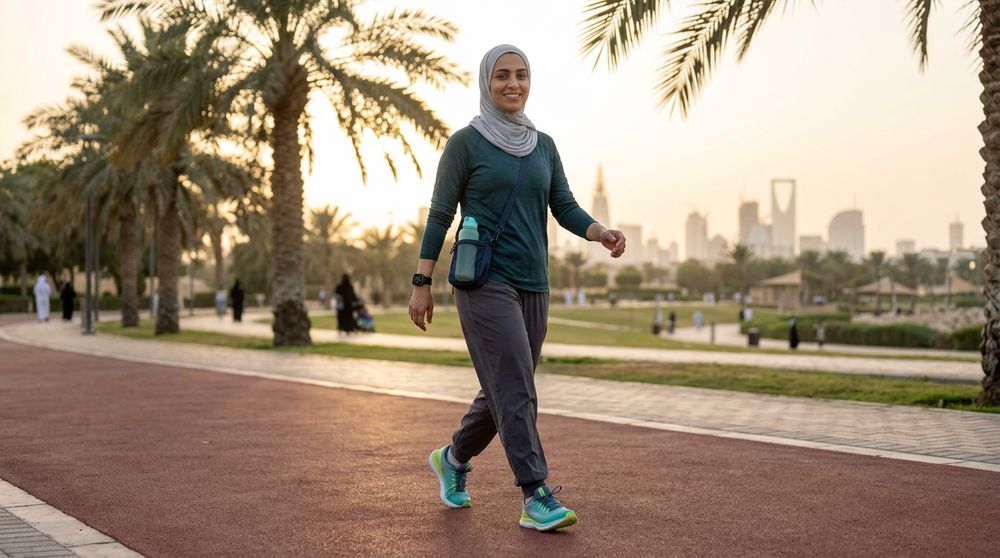
- Timing: best just after Fajr or from Maghrib until dinner. Avoid midday hours in the hot months.
- Place: air-conditioned malls, shaded park paths and neighbourhood walkways are all good, and so is a home treadmill on hot days.
- Water: drink a glass before walking, carry a bottle, and sip regularly in sessions longer than 30 minutes.
- Clothing and shoes: light, modest, breathable fabrics and comfortable shoes with shock-absorbing soles.
- Safety: choose lit, familiar routes and tell someone your walking time if you are alone.
Common mistakes that waste your effort
- Starting with a huge goal: jumping from 3,000 to 10,000 steps causes foot and leg pain and a quick drop in motivation.
- Relying on the number alone: 8,000 slow steps scattered through the day differ from 8,000 steps that include brisk walking. Combine both.
- Skipping strength work: walking does not build enough muscle, and your body needs resistance at least twice a week.
- Ignoring your shoes: old or tight shoes can cause heel or knee pain.
- Comparing with others: your watch is not 100% accurate, so trust your weekly trend, not one day's number.
- Eating back your steps: do not treat desserts as a reward for steps.
When to slow down or see a doctor
Talk to your doctor before increasing activity if you have heart disease, uncontrolled high blood pressure, diabetes or chronic joint pain, or if you are pregnant or postpartum. Stop at once and seek help if you feel chest pain, severe dizziness, unusual shortness of breath or sharp joint pain. This article is general educational information and does not replace a personal medical assessment.
Quick summary
- 6,000 to 8,000 steps is an excellent target for most people, and 10,000 suits those who want more.
- Benefits start early, and even 4,000 steps beats inactivity.
- Add 1,000 steps a week instead of jumping suddenly.
- Combine brisk walking with strength training twice a week.
- Walking supports a diet but does not cancel extra food.
- In Riyadh, choose dawn, post-Maghrib or air-conditioned places.
Frequently asked questions
Are 5,000 steps a day enough?
They are better than inactivity and give real benefit, but studies point to further gains up to about 7,000 steps, so treat 5,000 as a milestone, not the end of the road.
Do I need a smartwatch?
No. A phone app is enough, and if you do not carry your phone, count by time: about 10 minutes of brisk walking is often roughly 1,000 to 1,300 steps, depending on your height and pace.
Is walking after meals better?
A 10-minute walk after meals is an easy, useful habit for many people, especially if you feel sluggish after lunch, but it is not a requirement. Consistency matters most.
Can I split my steps across the day?
Yes. WHO guidance counts activity regardless of session length, so short scattered sessions count.
Are steps enough to build muscle?
No. They support the heart, mobility and calorie burn, but building and keeping muscle needs regular resistance training.
Sources
- Daily steps and health outcomes in adults: a systematic review and dose-response meta-analysis, The Lancet Public Health, 2025 — the link between 7,000 steps and health outcomes.
- The Lancet Public Health: Aiming for 7,000 daily steps can reduce risk of chronic diseases, cognitive decline, and death — press summary of the study.
- Daily steps and all-cause mortality: a meta-analysis of 15 international cohorts, Lancet Public Health, 2022 — how the target differs by age.
- WHO Physical activity fact sheet — adult physical activity recommendations.
- World Health Organization 2020 guidelines on physical activity and sedentary behaviour — 150 to 300 minutes and strength training.
Read also
- Warming up before training: a 10-minute dynamic routine
- Core training: 6 exercises smarter than crunches
- Muscle soreness after training: 7 recovery tips
Ready for the next step with Prof Health?
If you want a plan that brings walking, exercise, nutrition and psychological support together, try the 30-Day Challenge by Prof Health, with specialists who follow you in nutrition, fitness and mental wellbeing, or book a personalised consultation with The Professor over Zoom to set your step goal and a nutrition plan that fits your body and schedule. Start today; one extra step is enough to begin.